Tattoo Cover-Up in Savannah: What Can (and Can’t) Be Covered + Your Best Options
You’re stuck with an old tattoo you don’t love, and you’re worried a cover-up will look bulky, dark, or obvious. Maybe it’s a name you don’t want to explain anymore, a faded design that aged weird, or a piece that just doesn’t match who you are now. The good news: a cover-up can absolutely look like a fresh, intentional tattoo… if you approach it the right way.
A solid tattoo cover up in Savannah isn’t about “hiding” a tattoo with a bigger blob. It’s about using contrast, shape, and smart design choices so the old ink stops reading as the main idea. Below is what you need to know before you commit, what covers well, what doesn’t, and how to get a cover-up you’re actually proud to show off.
Helpful Links:
Cover-up fundamentals: what makes a cover-up work (and why some don’t)
A cover-up is basically a problem-solving project. Your artist isn’t starting with a blank canvas, they’re designing around what’s already there. These are the core factors that decide your best options.
1) Contrast: you can’t cover dark with light
This is the biggest misconception. If your existing tattoo has heavy black or deep, saturated colors, you generally can’t cover it with lighter ink and expect it to disappear. Skin is not white paper, tattoos live in the skin, so the old pigment will influence whatever goes over it.
What this means for you:
- Light florals, thin-line scripts, and airy designs usually won’t hide a dark tattoo.
- You’ll likely need darker elements in the new design (shadows, backgrounds, bold linework, richer color packing) to control what shows through.
2) Saturation: fully packed color covers better than “soft” color
Cover-ups typically require strong saturation , ink that’s packed solid, especially in the areas where the old tattoo is darkest. Styles like neotraditional , blackwork , and realism often cover well because they use intentional contrast and heavier values (dark-to-light ranges).
3) Size expansion: most cover-ups need to be bigger
A cover-up almost always needs to be larger than the original . That’s not the artist trying to upsell you, it’s math. You need enough room to break up the old shapes, add new shapes that distract the eye, and build in shadow and depth so the old lines don’t “ghost” through.
A good rule of thumb: expect the new tattoo to be 25–50% larger , sometimes more depending on how bold the original is.
4) Strategic linework: bold lines hide old lines
If your old tattoo has thick outlines, your cover-up generally needs bolder linework, or linework placed so it doesn’t mirror the old design, plus enough shading to blur the old structure.
Artists often use:
- Overlapping shapes
- Layered textures (fur, feathers, petals, scales)
- Decorative framing (ornamental borders, filigree, geometric panels)
5) Rework vs. cover-up vs. blast-over: they’re not the same thing
Not every “fix” is a traditional cover-up. Depending on your tattoo, you might get better results with:
Rework
Refreshing and correcting the existing tattoo (line cleanup, improved shading, better color). Best when you don’t hate the concept, just the execution or aging.
Cover-up
Building a new tattoo that makes the old one unreadable.
Blast-over
A bold new tattoo placed over an older one where you still might see parts underneath, done intentionally as a layered look (often with blackwork). Great if you like the “tattooed” aesthetic and don’t need the old ink totally invisible.
Common cover-up challenges (and what usually works)
Here’s what tends to be tricky, and how artists typically solve it.
Names and script
Script is often thin, but it’s readable, which makes it mentally “loud.” Even when it’s faded, your brain wants to decode it.
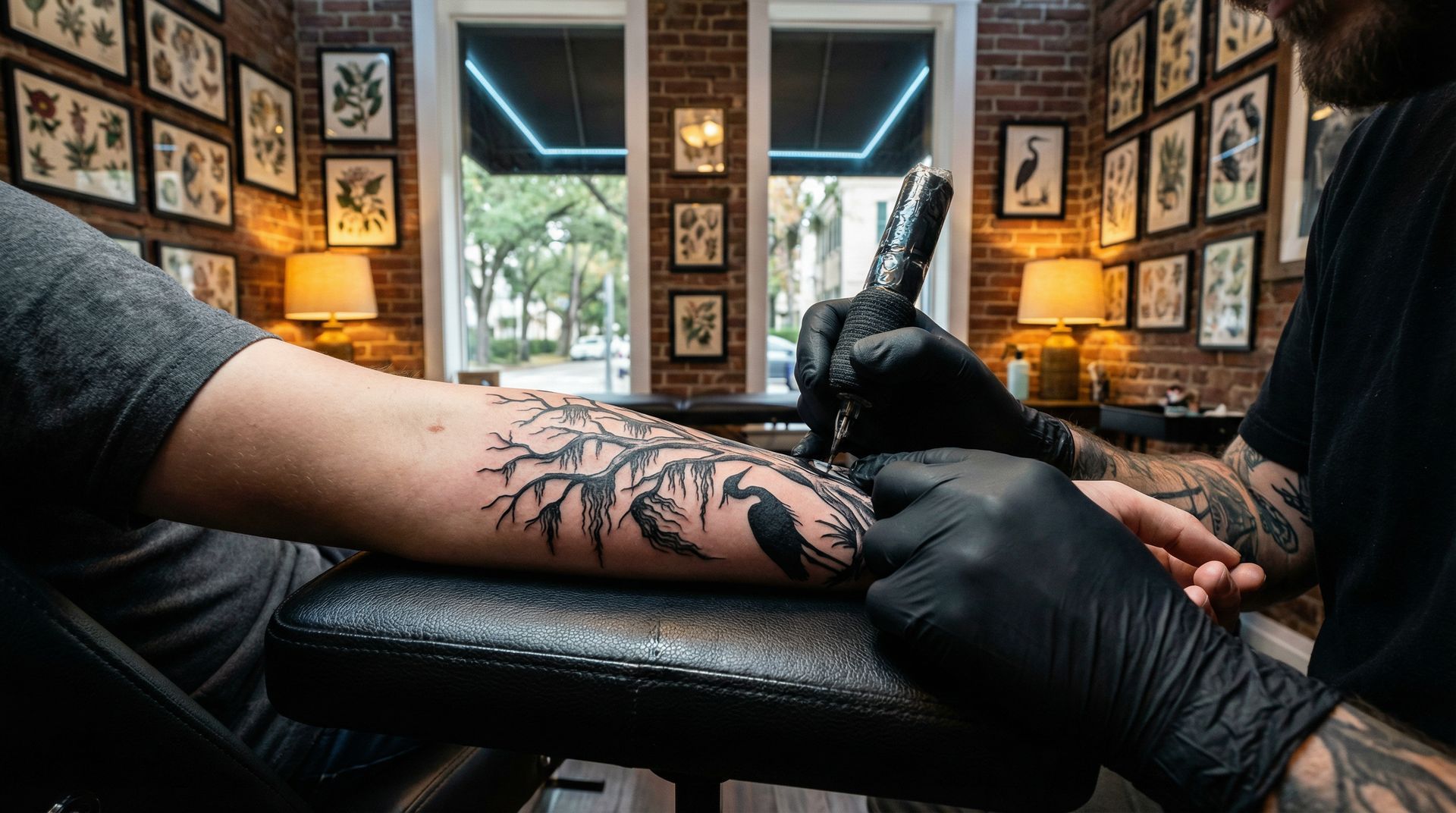
What covers it well: florals with layered petals, ornamental designs, feathers, animals with textured fur, or realism with a darker focal area where the script sits.
Heavy black areas
Big black shapes, tribal sections, or thick black bands can be the toughest.
What covers it well: designs that use black on purpose, blackwork, neotraditional with dark backgrounds, or realism that includes deep shadows (think: animals, skulls, roses with dark leaves, night scenes). In some cases, laser fading first gives you way more options.
Blowouts (ink spread)
A blowout happens when ink spreads under the skin, creating a fuzzy halo around lines. You can’t “erase” that with a cover-up, so the design needs to absorb it.
What covers it well: thicker lines, heavier shading, backgrounds, and textures that make soft edges look intentional.
Tip: Bring the truth, not the “best angle”
For a real cover-up plan, bring clear photos in good lighting (and be honest about age, touch-ups, scars, or past cover-up attempts). The more your artist knows up front, the better your design options, and the fewer surprises once the stencil goes on.
Alternatives and prep: when laser fading helps (and when it’s worth it)
A lot of people in Savannah assume laser is only for full removal. In reality, laser fading is often used to make a cover-up cleaner and more flexible.
When laser fading helps the most
- The old tattoo is very dark or heavily saturated
- You want a cover-up that’s lighter, more delicate, or more detailed
- You’re trying to avoid going much bigger
- You want color realism or a soft, dimensional look without a super-dark background
Even a small amount of fading can make the difference between “we can do this” and “we have to go way darker than you want.”
Timing considerations (don’t rush it)
Laser and tattooing both stress the skin. If you fade first, you’ll need to space things out so your skin can fully recover. Your artist will want to see skin that looks calm and stable before tattooing over it.
Also: if you live the Savannah lifestyle, sun, humidity, boating, Tybee days, you’ll want to plan around sun exposure. Freshly treated skin (laser or tattoo) needs protection and time.
Choosing subject matter that covers well
If your goal is “looks like a brand-new tattoo,” the design needs to be cover-up friendly.
| Proven Directions (Good for Covers) | What Usually Doesn't Cover Well |
|---|---|
| Florals: layered petals = built-in camouflage | Fine-line-only designs |
| Animals: fur/feathers create texture that breaks up old lines | Minimal shading |
| Ornamental: controlled symmetry can redirect attention | Tiny tattoos meant to “sit on top” of the old one |
| Dark backgrounds: creates negative space control | Light pastel-only color plans (unless old tattoo is very faded) |
| Realism: strong shadows can bury old elements |
Be honest about the original tattoo
This matters more than people think. Tell your artist:
- How old it is
- Whether it’s been touched up
- Whether it’s already a cover-up
- Any scar tissue, keloid tendency, or sensitive areas
- What you hate most (the subject, the placement, the vibe, the execution)
You’re not being judged. You’re helping the design land right.
Want a realistic cover-up plan?
Talk to the studio at 912-352-9926 and we’ll help you figure out your best next step.
Book a ConsultThe cover-up process: what to expect from consult to healed tattoo
A clean cover-up experience usually follows a predictable path. Here’s how it typically goes when you do it the right way.
1) Consultation: the real starting line
A proper consultation is where your artist checks darkness level, line thickness, skin condition, placement challenges, and your goals. You’ll talk style, blackwork, neotraditional, realism, and what subject matter fits both your taste and your cover-up needs.
If you already have inspiration, bring it, but keep it flexible. The best cover-ups are custom-fit to your existing tattoo.
2) Design options: expect a few different “routes”
A good artist may give you multiple paths, like:
- Option A: full cover, larger, darker background
- Option B: partial fade first, more detail, less dark overall
- Option C: blast-over, bold and intentional, some old ink visible
This is where you choose what you care about most: size, darkness level, realism/detail, or total concealment.
3) Session planning: cover-ups often take more than one appointment
Many cover-ups are one long session, but plenty are multi-session projects, especially if the original is very dark, the new tattoo is large, or you’re doing heavy color packing.
If you’re booking an appointment, remember a deposit is typically required to lock in your time , and it applies toward the tattoo.
4) Healing: cover-ups need good aftercare to stay crisp
Cover-ups rely on clean contrast. That means your aftercare matters, because excessive scabbing, picking, or sun exposure can blur the very details that help hide the old tattoo.
- First few days: swelling and tenderness are normal
- Week 1–2: peeling and itching are common
- Weeks after: the tattoo settles, contrast becomes clearer
Follow your artist’s aftercare instructions closely. Savannah heat and humidity can make healing feel extra “sticky,” so keep it clean, don’t over-moisturize, and avoid soaking until you’re cleared.
5) Touch-ups and long-term clarity: plan for longevity
With cover-ups, touch-ups aren’t a failure, they’re sometimes part of getting the best finish, especially where the original tattoo was darkest.
To keep your cover-up looking sharp over the years: use sunscreen once healed, moisturize regularly, avoid abrasive scrubs, and ask about a touch-up window if you notice a section healing lighter.
If you want to see different artist approaches, bold blackwork vs smooth realism vs neotraditional, browse portfolios before you commit: Meet the artists and see different cover-up-friendly styles →
What can’t be covered (without compromises)
To be straight with you: anything can be tattooed over, but not everything can be covered in a way that looks light, minimal, and totally invisible. You may need to compromise if:
- Your tattoo is extremely dark and you want a very light cover-up
- The old design is large and you want something smaller
- You want fine-line minimalism over thick, bold old lines
- There’s significant blowout or scarring that limits crisp detail
That’s where a consultation (and sometimes laser fading) makes the biggest difference, because it gives you a realistic plan instead of a hopeful one.
Your best next step in Savannah: get a cover-up plan you actually feel good about
A great cover-up should read like a brand-new tattoo, not like you’re trying to hide a mistake. When the concept is chosen to cover well, the sizing is honest, and the shading is intentional, your old tattoo stops being the headline.