Best Tattoo Styles for Your First Tattoo: Traditional vs Realism vs Fine Line (Pros & Cons)
You want your first tattoo to look amazing for years—but choosing the wrong style for your idea or placement can lead to fading, blurring, or regret. A design that looks crisp on a phone screen can age very differently once it’s living in real skin, dealing with sun, movement, and everyday wear.
Want help choosing a style that fits you? Call us at 912-352-9926 or book online.
We’ll help match your idea to the right style, size, and placement for longevity.
If you’re collecting first tattoo ideas , the best move is to start with style—not just subject matter. Style determines line weight, contrast, how readable it’ll be at 5–10+ years, and what size/placement you’ll need to avoid “mystery blob” problems later. Below is a straight-up comparison of the most requested styles we see in Savannah, plus how to match each one to your goals.
If you want to browse what these styles look like in real portfolios, start here: custom tattoo booking & info and meet the artists & view style examples.
The most requested tattoo styles (and how they actually age)
A lot of first-timers pick a style based on what’s trending. A better approach: pick a style based on longevity, readability, and how much detail your placement can hold .
1) American Traditional (Bold lines, classic icons, high contrast)
What it is: Thick outlines, limited but punchy color palette (or bold black/grey), classic imagery (roses, daggers, panthers, anchors, swallows, hearts, skulls).
Why people love it for a first tattoo:
- Readable from across the room
- Works well at smaller-to-medium sizes
- High contrast = strong longevity
How it typically ages:
Traditional tends to age very
well because the lines are bold and the shading is built for contrast. You’ll still want sunscreen once it’s healed, but this style is forgiving as skin texture changes over time.
The trade-offs:
- Less “soft” or delicate than newer styles
- If you want super-specific realism, traditional isn’t trying to be that
Best placements for first-timers: outer arm, upper arm, calf, thigh, shoulder blade—areas with decent surface space and lower daily friction.
2) Neo-Traditional (Traditional foundation with more detail + color play)
What it is: Like American traditional’s bold bones, but with more illustrative detail, expanded color palettes, smoother gradients, and more dimensional designs.
Why it’s a great first tattoo option:
- Still has strong outlines for aging
- Lets you add more personalization and “wow” factor
- Works for animals, florals, pop-culture concepts, and ornamental themes
How it typically ages:
Neo-traditional can age beautifully when the piece is sized correctly and keeps readable contrast (dark-to-light structure). Too much tiny detail can soften over time—so the key is not cramming
.
The trade-offs:
- Usually needs a bit more size than traditional to keep details readable long-term
- Larger pieces = longer sessions and higher budget
3) Realism (Portraits, lifelike animals, photo-inspired detail)
What it is: Highly detailed shading designed to look photographic—portraits, pets, movie scenes, hands, eyes, soft textures, and realistic depth.
Why people choose realism for a first tattoo:
- You want a specific person/pet/moment captured accurately
- You like smooth shading more than bold outlines
How it typically ages:
Realism can age well, but it’s the most dependent on proper sizing, placement, skin tone/texture, and aftercare
. Realism relies on subtle transitions—those can fade or soften if the tattoo is too small or placed where the skin stretches a lot. In sunny places (and yes, Savannah sun counts), contrast is everything.
The trade-offs:
- “Small realism” is where a lot of regret starts—tiny portraits and micro-realism often lose definition faster
- Usually better as a medium-to-large piece for longevity
- You may need a touch-up down the road to re-boost contrast
Best placements: upper arm, forearm (depending on sun exposure), thigh, calf, back/shoulder blade—areas that can hold enough space for detail.
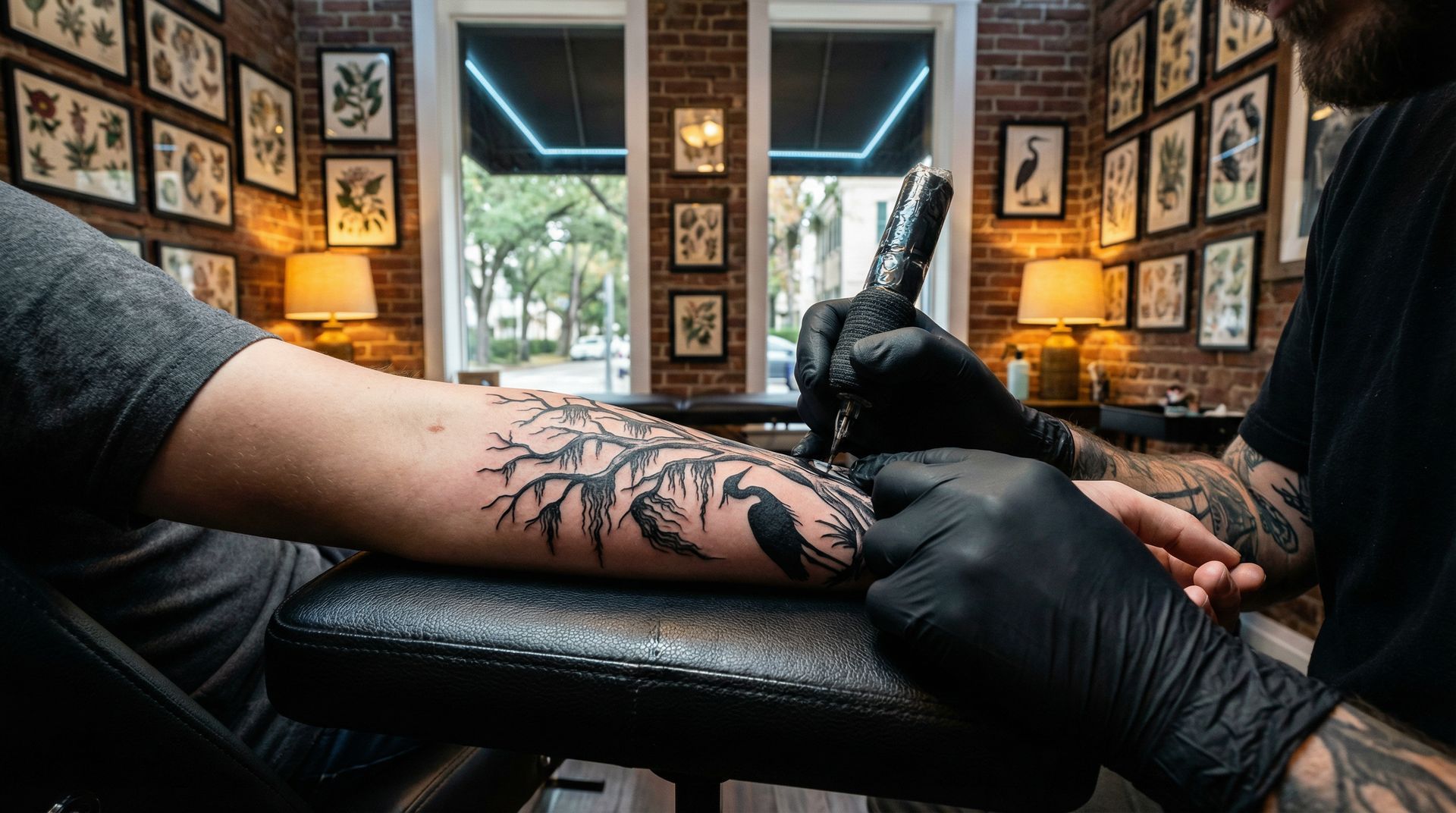
4) Blackwork (Heavy black, strong shapes, high impact)
What it is: Solid black shapes, bold patterning, geometric work, negative space designs, sometimes ornamental or abstract.
Why it works for first tattoos:
- Extremely readable
- Often ages well because it’s built on bold contrast
- Can be scaled from small to large
How it typically ages:
Blackwork tends to hold up well. Solid black can lighten slightly over time, but it stays readable. The main “risk” is if a design is too dense for a small area—then it can look visually heavy.
The trade-offs:
- It’s bold. If you want subtle, this may feel intense.
- Solid black requires good healing habits so it settles evenly
5) Illustrative (Drawing-like, stylized, often story-driven)
What it is: Think “artwork on skin”—sketchy lines, stylized shading, graphic novel vibes, whimsical or dark fantasy, custom characters, and designs that feel hand-drawn.
Why first-timers choose it:
- You want something personal and custom without being photorealistic
- It can be delicate or bold depending on line weight choices
How it typically ages:
Illustrative tattoos age based on line consistency and contrast
. A design with clear focal points and readable shapes stays strong. A design made of lots of tiny scratchy lines with low contrast may soften more quickly.
The trade-offs:
- The style range is huge—so it’s important you and your artist agree on what “illustrative” means before the stencil goes on
6) Fine Line (Minimalist, delicate, subtle detail)
What it is: Thin outlines, minimal shading, airy designs—tiny florals, script, micro symbols, delicate animals, minimal faces.
Why it’s popular for first tattoo ideas:
- Looks light and simple
- Often feels less intimidating than bold work
- Works for minimalist aesthetics
How it typically ages (the honest version):
Fine line tattoos can age nicely, but they’re the most vulnerable to blurring and fading
if the design is too small, placed in high-friction zones, or lacks enough spacing. Skin isn’t paper—thin lines naturally soften as years pass. If you want fine line, the smartest move is usually to go slightly larger than you think
and keep the design clean.
The trade-offs:
- Micro tattoos can become harder to read over time
- Super-thin script is one of the most common “I wish I sized this up” regrets
When you choose a style, ask: “Will someone still understand what this is from 6 feet away in 5–10 years?” Styles with bold contrast (traditional, neo-traditional, blackwork) usually win longevity. Styles with subtle contrast (fine line, some realism) need smarter sizing and placement to stay crisp.
Match the style to your goal (so you don’t outgrow it)
Now let’s connect style to intent. This is where a lot of first-timers get unstuck.
If you want a meaning-heavy tattoo (symbols, dates, reminders)
Best fits:
American traditional, neo-traditional, illustrative, blackwork
Why:
These styles keep icons readable and can build symbolism into the design (flowers, animals, objects, framing, banners, etc.).
Avoid this common mistake: going too small with too many elements (especially on wrists/hands). If it matters, give it room.
If you want a portrait tattoo (person or pet)
Best fits:
realism (sometimes illustrative realism depending on vibe)
Sizing reality:
portraits almost always need to be medium or larger
to keep facial features readable long-term.
Placement guidance: pick an area with enough flat space and less stretch—upper arm and thigh are common wins.
If you want minimalist tattoos (tiny icons, subtle linework, simple florals)
Best fits:
fine line, light illustrative, minimal blackwork
Key to longevity:
increase spacing and simplify shapes. The tattoo should breathe. Tiny tight details merge faster.
Placement guidance: inner arm, outer forearm, upper arm, ankle (with caution), behind the ear (with caution). Areas that rub a lot or see tons of sun tend to age faster.
If you want a bold statement piece (you want it to pop)
Best fits:
American traditional, neo-traditional, blackwork
Why:
bold line weight + clear contrast looks strong across the room and stays readable.
Placement guidance: upper arm, forearm, calf, thigh, chest—give the design a canvas.
Color vs. black/grey: what first-timers should know
- Color tattoos can be vibrant and fun, especially in traditional and neo-traditional work. They may require more sun protection to keep saturation strong.
- Black/grey (especially blackwork and many realism pieces) often reads cleaner over time, and it’s easier to maintain contrast.
Savannah-specific reality: if you’re outdoors a lot—walking River Street, spending weekends near Tybee, or working in the sun—your healed tattoo will thank you for consistent sunscreen and a little extra thought about placement.
Size + placement: the “aging math” nobody tells you
Here’s the rule that saves a lot of regret: the more detail you want, the larger the tattoo needs to be . Skin cells don’t hold microscopic detail forever. Over time, ink naturally spreads a bit under the skin.
A few quick guidelines:
- Fine line script: go larger than you think, keep letters simple, avoid ultra-thin strokes.
- Realism: don’t try to cram a portrait into a 2-inch space.
- Traditional/blackwork: can go smaller because the shapes are built to be bold.
If you’re unsure, a consultation is where you translate your idea into a piece that will actually hold up.
Want help choosing a style that fits you? Call us at 912-352-9926 or book online.
Bring your idea—we’ll help you choose what will look best now and years from now.
First-tattoo planning checklist (so your consult is productive)
You don’t need to show up with a perfect Pinterest board. But a little prep helps your artist guide you to the right style, size, and placement.
1) Bring reference images (but know what they’re for)
Bring 5–10 images that show:
- The style you like (fine line vs. traditional vs. realism)
- Subject matter (snake, rose, portrait, etc.)
- Shading preference (smooth vs. pepper shading, high contrast vs. soft)
- Placement inspiration (similar body area)
Pro tip: It’s totally okay if your references are different subjects. What matters is that they communicate the vibe .
You can also look through recent studio updates for inspiration: studio updates & latest posts.
2) Set a realistic budget (and understand deposits)
Custom tattoos are priced based on size, placement, complexity, and session time. If you want realism or neo-traditional with a lot of detail, plan for a bigger investment than a simple minimal piece.
For appointments , a $100 deposit is required to secure your booking, and it applies toward your tattoo . If you’re more spontaneous, walk-in tattoos are available 7 days a week , which is perfect when you’re in town and ready to go.
3) Think through pain + placement without over-stressing
Everyone’s pain tolerance is different, but here are general first-tattoo-friendly zones:
- Upper arm / outer arm
- Forearm (varies person to person)
- Calf
- Thigh
Areas that tend to feel spicier (and can be tougher for fine line longevity due to friction/stretch):
- Ribs, sternum
- Hands, fingers
- Feet, ankles
- Inner bicep, elbow ditch, knee ditch
Your artist can help you choose a placement that matches your style and your comfort level.
4) Plan timing around travel, swimming, and workouts
If you’re scheduling around life in Savannah, be smart about:
- Beach/swimming: Don’t plan fresh ink right before you want to be in pools, the ocean, or hot tubs. Healing skin + water exposure is a bad mix.
- Workouts: Heavy sweat and friction can irritate a new tattoo. If the tattoo is in a high-rub area (thigh, ribs, under bra straps, waistband), build in downtime.
- Work uniforms: If your job involves friction, sun, or dirt, talk through aftercare logistics at your consultation.
5) Know how to describe what you want in a consultation
You’ll get better results if you explain:
- The story/meaning (if any)
- Must-have elements vs. flexible elements
- Style preference (traditional, realism, fine line, etc.)
- Where you want it and approximate size
- Color vs. black/grey
If you’re also considering body jewelry upgrades while you’re in, you can review services here: professional body piercing info.
Quick pros & cons recap (easy decision helper)
American Traditional
Pros:
ages well, bold, readable
Cons:
less delicate, classic look isn’t for everyone
Neo-Traditional
Pros:
bold + detailed, great color options
Cons:
needs space/budget for detail
Realism
Pros:
lifelike portraits and depth
Cons:
sizing matters a lot; tiny realism often doesn’t age well
Blackwork
Pros:
high impact, strong longevity
Cons:
very bold; dense pieces need thoughtful placement
Illustrative
Pros:
unique, custom, artistic range
Cons:
depends heavily on contrast and line choices
Fine Line
Pros:
minimal, subtle, modern
Cons:
most vulnerable to blur/fade if too small or too tight
If you want a simple next step, choose your top two styles and then decide based on placement + longevity . That combo usually makes the answer obvious.
You can also grab a gift card if you’re not ready to commit to the exact design yet: gift cards & merch.
Ready to choose the right style for your first tattoo?
Tell us your idea, where you want it, and the look you’re going for—we’ll help you land on a style that stays readable and looks great long-term.
Want help choosing a style that fits you? Call 912-352-9926 or book online.
Fastest way to get started: click the button and request your booking.